

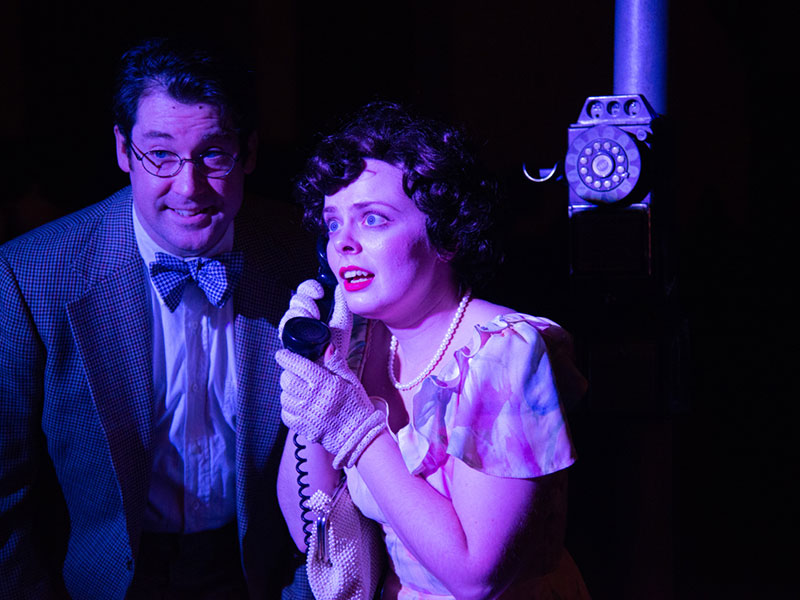
Dream Girl
by Elmer Rice
St. Mary’s Church, Hamilton Village 3916 Locust Walk
February 5 – 24, 2018
Directed by Tina Brock
Setting
New York City, 1945
8:00 am – 3:30 am
One Day in the Life of Georgina Allerton
Running time is approximately 93 minutes, with no intermission.
Costume Designer
Erica Hoelscher
Lighting Design
Joshua L. Schulman
Sound Design
Tina Brock
Stage Manager / Board Operator
Madison Caudullo
Properties Master
Mark Williams
Stage Interiors and Settings
Tina Brock & Mark Williams
Ways and Means Coordinator
Bob Schmidt
Assistant Costume Designer
Mary Ann Swords-Greene
Photoshop Magic
Bill Brock
Photography
Johanna Austin / AustinArt.org
MUSIC/COMPOSER ATTRIBUTION
Special thanks to the following artists:
George Gershwin, Rhapsody in Blue
Duke Ellington and His Orchestra, The Five O’Clock Whistle
Dizzy Gillespie, Bebop
Art Blakey, A Night at Birdland
The Lounge Lizards, The Voice of Chunk
Henry Purcel, 10 Sonatas in Four Parts
John Coltrane, My Favorite Things
Leroy Anderson, The Typewriter
John Zorn: Filmworks XXIII, Besos De Sangre
Three Leg Torso, Animals and Cannibals
Jazz Passengers Featuring Deborah Harry/Elvis Costello,
Individually Twisted
Bill Frisell, Good Dog, Happy Man
The Mexican Mariachi Band from Adelaide (with Trumpet)
John Zorn, John Zorn@60
Reviews
Dream Girl (2019)
“...IRC forever deserves commendation for their commitment to a canon most companies wouldn’t go near...”
--Cameron Kelsall, The Broad Street Review
Dream Girl (2019)
“...if his dreams led to such wonderful writing, shouldn’t we all be daydreaming more often... the sprawling space is deftly exploited...”
--Margaret Darby, DelcoCultureVultures.org
Dream Girls (2019)
“...the copy from my town library was last checked out in 1963....”
--Toby Zinman, The Philadelphia Inquirer
Dream Girl (2019)
“...you’ll likely not have another opportunity to see Dream Girl — even the film version, starring a very well cast Betty Hutton, has pretty much vanished... this company is one of Philadelphia’s most ambitious and out-of-the-box...”
--David Fox, Philadelphia Magazine
Dream Girl (2019)
“...direction deserves much praise...fun treatment of a lightweight but amusing play ...lively offering of light entertainment
...an enjoyable evening.”
--Richard Lord, University City Review
Dream Girl (2019)
“...the production is directed stylishly...
the seven-member cast seamlessly takes on 32 roles, each well-defined by Erica Hoelscher’s costume design.”
--Howard Shapiro, Shapiro on Theater, WHYY.org
Dream Girl (2019)
Director's Notes
Welcome!
Recently the question was posed as to how play selection works at the IRC.
I’m guessing like most theaters, I keep a list of must do stories that seem right for the IRC’s aesthetic and sensibility given our mission. About a year out, we consider which plays work for the season, the current mood of the country and availability of the proper setting within which to tell the story. Since 2010, the IRC had performed out of the Walnut Street Studio’s Studio 5 space, a 53-seat black box that allowed us to grow our audience and our aesthetic over the years. The dedication last year of the space as a teaching-only facility found us scouting a new home for this show. It was suggested that the St. Mary’s Sanctuary might be a fit, and we know and love the space already as we rehearse in the Bearded Ladies Cabaret in the basement of the church. The beauty of the Neo-Gothic architecture suggests the vastness and scope of Manhattan; the questions raised in the play about a life well-considered seem to fit snugly in the walls surrounding us now.
Producing in found spaces presents many opportunities and challenges that you will see and experience during the show. As we worked through the placement of the differing locations in the play among the nooks and crannies of this magnificent structure, it was hard not to be awed by the creation of this space, the many communities it serves, and the many gatherings over the years it has hosted.
Circling back to the reason for the play’s selection and the idea of what we consider our sanctuaries in difficult times; conversations over the last couple years have inevitably lead to the particular ways people are coping with life, the methods they are using to refuel, hideaway, and find the space to think and breathe in what seems like an abnormally surreal, difficult to navigate day to day existence.
Remembering the directive to “stop daydreaming and get moving” when I was a child, I wondered then how and if daydreaming gives us the space and the courage to give our dreams a practice run, if they in fact aren’t the first step in the process of bringing those dreams to life. Instead of considering daydreaming as only a diversion, what if it becomes a necessary diversion to moving one’s life forward one fantasy at a time -- a practice that perhaps has been frowned upon in recent years when productivity and efficiency are valued measurements for validity like an abnormally surreal, difficult to navigate day to day existence.
These reasons, plus a love of anything New York City in the 1940’s, a love of two gals fighting to save the thing they care about most, and a soft spot for getting lost in the stacks of book stores for hours, brought me to this combination of story and space.
Thank you for joining us tonight, we hope you will share the IRC story with 10 friends and join our mailing list to see how this detective story of small company searching for home base continues. We are thankful to each and every audience member for their generosity over the years which has brought us to our first three -show season in the company’s history. We are Dreaming Big for the years to come and look forward to seeing you in the audience as we forge our way to save this bookstore together. A hearty thanks to the staff at St. Mary’s for their flexibility in this first ever full run theater collaboration, and to this cast for their adventurous spirit in bringing this quirky little story to the stage. It’s been an illuminating experience for me and one I will always remember.
SPECIAL THANKS
Brittany Holdahl
The Reverend Mariclair Partee Carlsen, Scott Wilds
and the Congregation of St. Mary’s
Mark Williams
Victor Keen and Jeanne Ruddy
Delaware Theatre Company
Lehigh University Department of Theater
Bill Brock
Robin Rodriguez
Marcia Ferguson
Cyndi Jansen Rose
Ben Doranz
Avista Custom Theatrical Services
Gerald Kolpan - The Philo Project
Program Cover Art
Based on Metro Goldwyn Mayer’s The Thin Man
The IRC is a proud participant in the Barrymore Awards for
Excellence in Theatre, a program of Theatre Philadelphia www.theatrephiladelphia.org
Dream Girl is presented by special arrangement with Samuel French, Inc.
Program Cover Art
Based on Metro Goldwyn Mayer’s The Thin Man
The IRC is a proud participant in the Barrymore Awards for
Excellence in Theatre, a program of Theatre Philadelphia
www.theatrephiladelphia.org
Dream Girl is presented by
special arrangement with Samuel French, Inc.








delcoculturevultures.com
Review: The Idiopathic Ridiculopathy Consortium’s ‘Dream Girl’ at St. Mary’s Church in Hamilton Village
By Margaret Darby
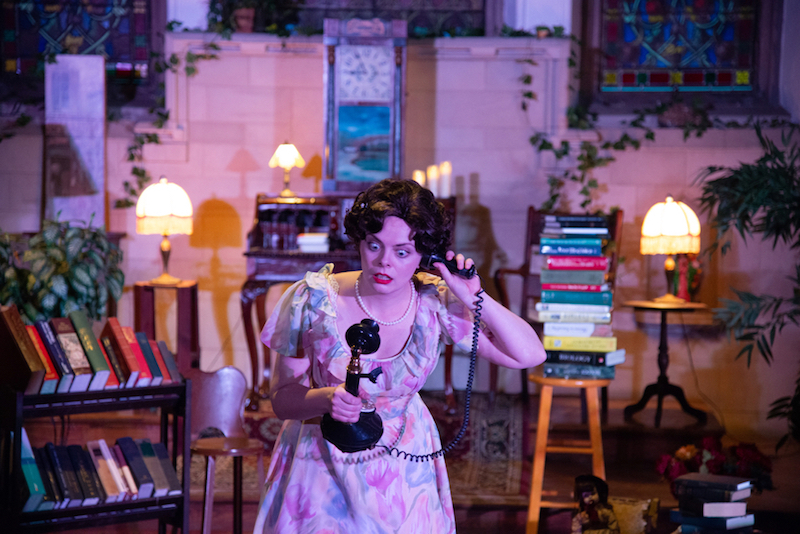
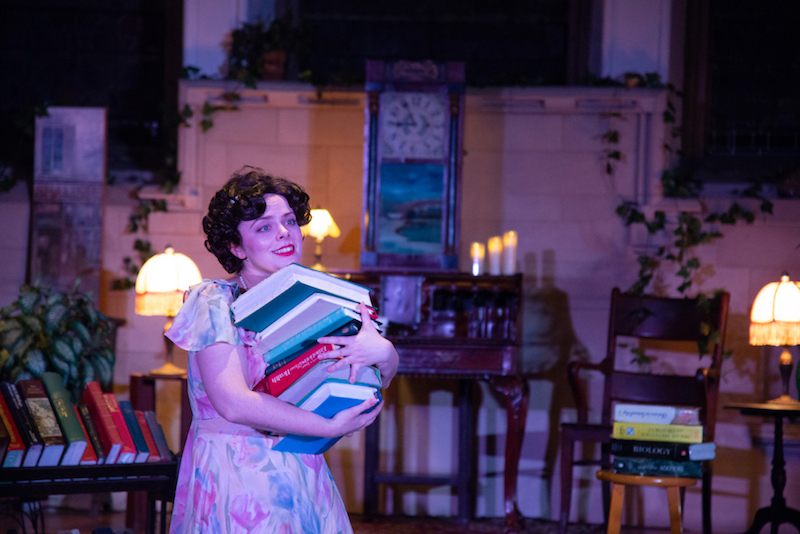
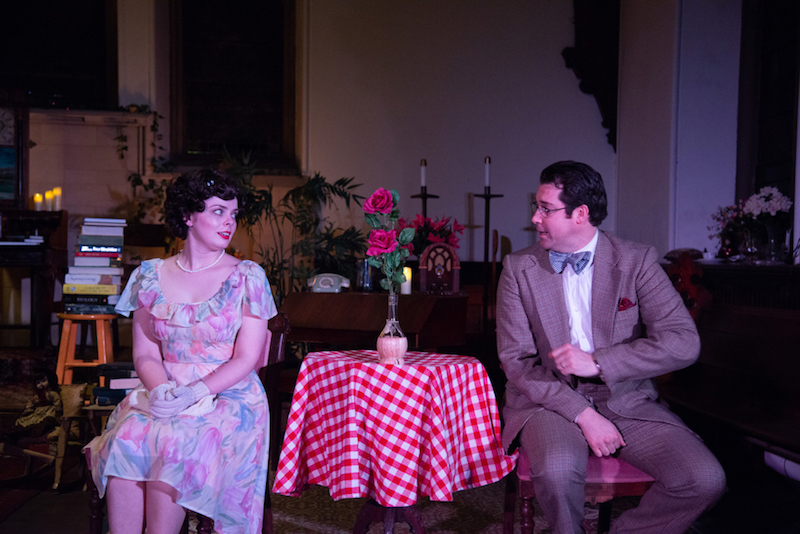
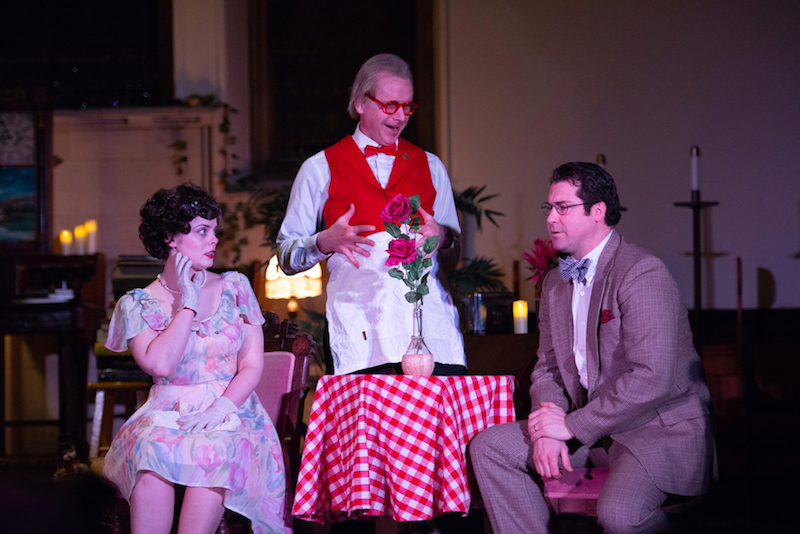
The sanctuary of St. Mary’s Episcopal Church in the heart of the Penn campus is a large space with many, many nooks and crannies. Those nooks and crannies were filled with intriguing 1940s memorabilia, ably assembled and dispensed by Tina Brock and Mark Williams. If you come early enough to snoop, look at the museum-quality toaster, books spread throughout, the toothbrush in a wash basin, the letter to Georgina Allerton from a publishing house, unopened and suspiciously thin. The set and props put one in the swing of 1940s New York.
Swing is also in the soundtrack – and jazz. John Coltrane’s “My favorite things” plays while Mrs. Lucy Allerton (Tina Brock) and Mr. George Allerton (Paul McElwee) sit quietly reading at the breakfast table. Sitting and reading is fascinating when Brock and McElwee do it – although I could not tell you why. A twitch here, a sneeze there, a sip of coffee, and they mesmerize the audience, even the two young children sitting in my row.
The action begins with Georgina’s alarm clock – the only reality we see in her life for a while as she goes directly from sleep into a radio-induced daydream trance. Brittany Holdahl, as Georgina, is full of energy in her debut with the IRC, but does not have quite the projection nor slower pacing required for this cavernous church space. Her gestures and coltish youthfulness communicate a great deal without words, though, and her swaying in and out of her daydreams has an ingénue charm.
Alas, her letter from the publisher is a rejection – another splash of cold water on the dreaming girl’s ambitions. She rushes to her bookstore job where she accomplishes more dreaming than bookselling. Into her bookstore walks a tall drink of cold water: the rough-and-tumble Clark Redfield (Kyle Fennie), a reporter whose directness startles the flighty Georgina.
She, of course, wants to wait for more entrancing suitors, like the rich roué who promises glamorous getaways, George Hand. He is played with snobbish elegance by Brian McManus, who sweeps Georgina off her feet with tempting offers of travel and adventure. She is torn between what her sincere but gruff suitor and the chimeric dream of life with a dashing dazzler.
Of the twelve male and one female characters played by Paul McElwee – the three waiters with totally different postures, idiosyncrasies, and styles are worth the show’s admission – what a master! Also commendable for their speed and character differentiations are Dexter Anderson’s eight characters. Anna Pysher, who in her IRC début, transformed herself completely for her four different roles.
The sprawling space is deftly exploited – with characters coming from all directions, sometime stopping to telephone one another across the stage. The costuming by Erica Hoelscher was brilliantly conceived as characters changed back and forth with lightening speed, moving instantly from prim to prurient, doctor to waiter, doddering district attorney to dashing roué. Doors in the sanctuary burst open for surprise entrances and a large window casement became the Allerton parent’s bedroom.
This play was my introduction to playwright Elmer Rice, who won a Pulitzer Prize for drama for his 1929 play Street Scene, in which he portrayed the sobering reality of poverty for the stage. Although he was poking fun of Georgina and readers of dreamy romance novels in Dream Girl, he was also showing us his own dreams. If his dreams led to such wonderful writing, shouldn’t we all be daydreaming more often?
[The Idiopathic Ridiculopathy Consortium presents Dream Girl St. Mary’s Church, Hamilton Village, 3916 Locust Walk, Philadelphia, February 5-24, 2019. Tickets for Dream Girl are $15 – $25, and available at DreamGirl.bpt.me or by calling 215.285.0472]
~~~~~~~~~~~~~~~~~~~~~~~~~~~~~~~~~~~~~~~~~~~~~~~~~~~~~
Philadelphia Magazine
REVIEW: American Dreaming: Freud on Broadway, c. 1945
BY DAVID FOX ON FEBRUARY 8, 2019
If you’ve received recent emails or checked out the Idiopathic Ridiculopathy Consortium (hereafter IRC) website—and if you haven’t, you should, because this company is one of Philadelphia’s most ambitious and out-of-the-box—you will have seen promotional images for Dream Girl, Elmer Rice’s 1945 comedy in which Georgina Allerton, a young woman with a drab daily life, imagines herself in far more interesting fantasies. The poster and photos are utterly delightful, evoking a just-post-WWII Manhattan full of glamour and possibility.
That’s no surprise because Tina Brock (who runs the company and also appears here, delightfully, in a small role) is as stylish a director as one could hope for.
Some of that style is on view in Dream Girl, but the net effect is disappointing. Seen here, it’s a three-fold problem. The play itself, though not without some intriguing ideas, is fusty; perhaps to compensate, the production is overly heightened. Most damagingly, the St. Mary’s Church space, visually appealing, is so cavernous and echoey that it’s virtually impossible to see and comprehend the action.
Too bad, because there are fascinating elements to consider. At a time when other American writers were largely fixated on the “American Dream” mythology of success, Rice ponders dreaming on a more Freudian level—as an expression of the repressed self. In this, Dream Girl is in line with Moss Hart and Kurt Weill’s Lady in the Dark, and even more directly, Thurber’s story, “The Secret Life of Walter Mitty.” (Rice acknowledged the latter as an influence.)
Many will know Mitty from its famous 1947 film, a showcase for the antics of Danny Kaye. That’s how I knew it, certainly. Frankly, I’ve had a lifelong aversion to Kaye—even as a child, I thought he was finding himself ever so much funnier than I was. He was working too hard and too obviously to land the humor.
A similarly frantic tone takes hold here in Dream Girl, where I think it too often derails Brock’s really good ideas. For example, she has cast Georgina (Brittany Holdahl) and her sister, Miriam (Anna Pysher), with actors who are astonishingly alike physically. The implication—that they might be doppelgängers—is a layer of fragmentation that Rice likely didn’t imagine, but it fits. It also reinforces the stylistic notion of Absurdism that is an IRC staple. Yet in the end, not much comes of this, as the production’s tone takes a less thoughtful and more farcical approach.
Broad farce also overwhelms what to me is the play’s most poignant theme—and indeed, a core issue in several of the works where America begins to flirt with Freud. That would be the unanswerable question of whether Georgina is more her “genuine” self in her daily life as an adventure-free working girl or in her fantasies, where she’s glamorous, risk-taking, and personally and romantically fulfilled.
I’d love to see this latter idea truly anchor a production that could also explore more deeply questions of female roles in the socially rigid late 1940s, when women who briefly held together our workforce in jobs that gave them real opportunities were expected once again to recede into the background.
But though IRC’s Dream Girl hints at all this, it’s ultimately the broad comedy that engulfs it. The ensemble cast certainly follow through on that tone—it’s consistent throughout—but I don’t think it hits the mark. In any case, the whole thing gets swallowed up in the space.
Still, there are good reasons to see the show. Rice is an important but now largely forgotten writer, and I love that Brock and company champion him here. You’ll likely not have another opportunity to see Dream Girl—even the film version, starring a very well cast Betty Hutton, has pretty much vanished.
In any case, you should absolutely consider seeing the next two shows on IRC’s season: Betty’s Summer Vacation and Come Back Little Sheba. Brock is the only director I know audacious and imaginative enough to combine Rice, Christopher Durang, and William Inge in a single season! (The next two shows will also very likely be presented in more conducive spaces.)
In the meantime, what we have here in Dream Girl is, perhaps, closer to a dream deferred than a dream come true.
Dream Girl plays through February 24. For more information, visit www.IdiopathicRidiculopathyConsortium.com.
~~~~~~~~~~~~~~~~~~~~~~~~~~~~~~~~~~~~~~~~~~~~~~~~~~~~~
University City Review
Dream Girl Revival Captures A Bygone Era Of Popular Theatre
Wed, Feb 13, 2019
By Richard Lord
Contributing Writer
Today, the name Elmer Rice is largely a head-scratcher, even among theatre lovers. But for a thirty-year stretch, from about 1915 to the end of the Second World War, Rice was one of America’s most popular and successful playwrights.
Rice was astoundingly prolific, with literally dozens of his plays having received production during his heyday. In our time, Rice is mostly known – by those who do know him at all – for three plays: The Adding Machine, Street Scene and Dream Girl. That latter is now on offer by the Idiopathic Ridiculopathy Consortium, a.k.a. IRC.
The title lady of Dream Girl is Georgina Allerton, and the play invites us into her world, including a netherworld of her churning fantasies. Georgina runs a bookstore in the heart of New York. This, remember, was a time when books were major events and bookstores were not yet an endangered species. However, the shop Georgina and her partner run is fighting for survival: on the morning that the play opens, total sales have been a single three-penny postage stamp.
Meanwhile, Georgina wallows in the tepid waters of banality and early on admits that she’s afraid of stumbling into middle age without experiencing anything. So she escapes her humdrum life via lavish daydreams that bring her into worlds she’ll most likely never visit in reality. She’s also written a romantic novel that has been collecting a steady flow of rejection slips.
Georgina remains unmarried in her mid-twenties, which has both Georgina and her parents concerned. (Biological clocks seemingly ran faster back in the Forties.)
It’s not that she’s so busy on a career track that she has no time for relationships; she’s been the victim of bad luck and bad choices. Case in point: this Dream Girl’s dream guy is her own brother-in-law, Jim Lucas. Jim works as an editor at a publishing house and is considered “undependable” by his wife and his parents-in-law.
Two other men play key roles in Georgina’s attempt at a life. The first is Clark Redfield, a book reviewer for a major New York newspaper who’s found a way to review books without actually reading them, and George Hand, a well-to-do married man who has little regard for marital fidelity.
As all the above suggests, Dream Girl draws on many of the themes and conventions of romantic film comedies of the 1930 and ’40s, as well as the screwball comedies of that period. (If you’re an aficionado of that Golden Age of romantic comedies, you’ll possibly be able to guess the end of this play early on.) It uses the tropes so blatantly, it’s probable that Rice intended Dream Girl as a parody of the genre – but if so, it’s an utterly affectionate parody.
Maybe he should have been a bit less affectionate actually. Rice observes all the conventions of the rom-com genre, but never turns any of them on their head, or even gives them an inventive twist. While the dialogue is fairly clever, it never reaches the sabre-point wit or rapid-fire repartee of the best films and plays of the period.
Rice also presents a roster of characters who are a bit quirky and mildly engaging, but none so original that we’re ever riveted by them. In fact, it’s fair to say that most of the principles are closer to caricatures than to fully drawn personalities.
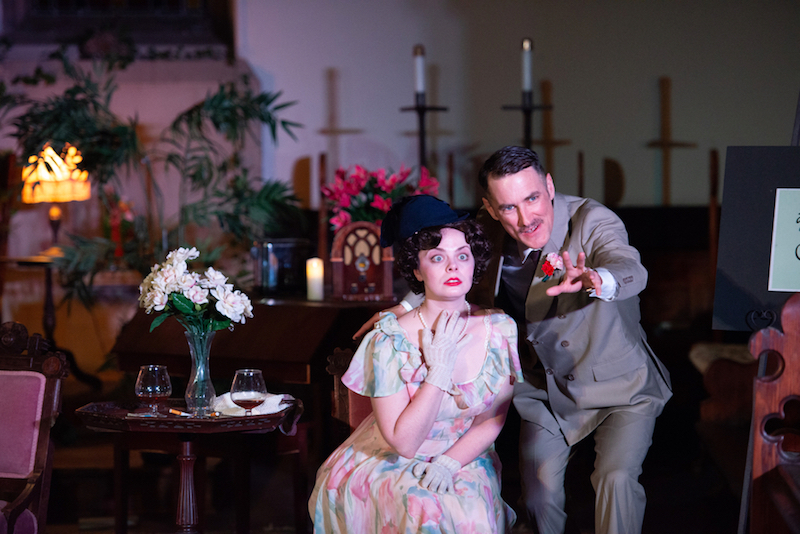
Accepting these shortcomings, the IRC decided to take on this play and give it new life. Having lost their former venue at the Walnut Street black box, they took a chance by staging it in the main body of St. Mary’s Church, an imposing structure on the Penn campus that first opened in 1874. Most of the action takes place in the church’s south transept, though some fantasy bits flow down the central aisle or in the crossing transept.
The space proved to be rather problematic, though the IRC staging was resourceful enough to overcome many of the problems, even at times turning a seeming obstacle into a virtue.
Overcome most of the problems, but not all. A serious recurring problem here: the acoustics are not kind to the staging of a play, so dialogue is sometimes hard if not impossible to hear, with key lines getting lost in the ether.
More, some sight lines were totally blocked for people sitting in the main pews, which meant that several short scenes were lost to audience members in those seats. I would recommend that you get to the church early and grab a seat up front. A seat in the front row of the main pews, all the way to the left, might be best.
Taking into account that this is more of a theatrical frolic than a serious piece of drama, the IRC production found the right tone for bringing the material to life. The pacing is fittingly brisk with quick jumps from one scene to another, even from the real world to Georgina’s fantasy excursions. Joshua’s Shulman’s lighting design helps out considerably here, though there are dream scenes where the lighting could be more obvious in transporting us to another dimension.
The hectic production, covering the tricky space, was a rigorous test for the eight-member cast, but they pass the test admirably. For much of the show, actors play their roles broadly, but just enough: never are they so broad as to make their characters cartoonish.
At the center of all the action is Brittany Holdahl as Georgina. This Georgina is likeable despite all of her flaws and foibles. Holdahl manages to combine naiveté, cautious skepticism and New York moxie in a believable mix. She also uses facial gestures well, which is needed, as many of her more important lines are swallowed up in the awkward acoustics.
Dexter Anderson’s Jim Lukas is even more likeable despite his even deeper flaws. Anderson was also the one actor in a central role who managed to surmount the auditory problems of the venue and render almost all of his lines completely clear and comprehensible.
Kyle Fennie gives us a solid though strangely low-key Clark Redfield. Fennie’s Redfield is a recognizable denizen of vintage rom-coms who embodies a New York state of mind, circa 1945. He works commendably to overcome the limitations of the character Elmer Rice presented.
Brian McManus is also commendable as George Hand, as is Paul McElwee as George Allerton, Georgina’s father. (Rice seemed to like the name George and its permutations.)
Tina Brock is a steady presence as Georgina’s mother, which is not easy to pull off as this is a character teetering at the edge of cliché. Anna Pysher is effective in the subsidiary roles of Georgina’s sister Miriam (Jim’s wife) and her bookstore business partner. And we should note that every actor except for Holdahl took on more than one role, though most of these were walks-ons and rush-offs. (The rapid costume and wig changes alone were impressive.)
Tina Brock’s direction deserves much praise for both finding and maintaining the right tone for the performances as well as the resourceful staging. And we should also give a nod to Brock and Mark Williams for their set design, which gives a nice Forties flavor to the show. Erica Hoelscher’s costume designs add a further period zest to the production.
This is a fun treatment of a lightweight but amusing play, and if you go in expecting nothing more than a lively offering of light entertainment absent any great depth or statement, you should have yourself have an enjoyable evening.
Dream Girl runs at St. Mary’s Church, 3916 Locust Walk, Philadelphia from Feb. 5 – 24. For tickets and further info: 215.285.0472.
~~~~~~~~~~~~~~~~~~~~~~~~~~~~~~~~~~~~~~~~~~~~~~~~~~~~~
The Philadelphia Inquirer
REVIEW
‘Dream Girl’ at IRC: A dull, lifeless trudge
Updated: February 8, 2019 - 11:58 AM
Toby Zinman
Leave it to Tina Brock to unearth Elmer Rice’s Dream Girl. The comedy opened on Broadway in 1945, and the copy from my town library was last checked out in 1963. Perhaps this is one of those leave-well-enough-alone moments. Idiopathic Ridiculopathy Consortium (a.k.a. IRC) is Brock’s eccentric company, specializing in rediscoveries and reinvigorations since 2006. Lately, the company has moved from the European absurdists to the American nostalgists: IRC’s recent brilliant production of Tennessee Williams’ Eccentricities of a Nightingale turned out to be the perfect vehicle for its talents and sensibilities.
Unfortunately, Dream Girl is an uphill trudge, mainly because the venue’s acoustics made the dialogue largely unintelligible, so that even the simple plot was hard to follow. Not to mention the hardness of the pews and the hopeless sightlines. Not to mention the weakness of Rice’s script.
The plot depends on a gimmick: Georgiana (Brittany Holdahl) is a daydreamer (thus the title); she runs an unprofitable bookshop, has written an unpublishable novel, and is, sadly, secretly in love with her sister’s husband, Jim (Dexter Anderson). So what’s a girl to do if not daydream about a romantic, adventurous, glamorous life where rich seductive men whisk her off to Mexico and she substitutes for a famous actress as Shakespeare’s Portia? The dramatic device works this way: As reality crowds in on her, she will raise a hand to her cheek, gaze off in the upper distance, run offstage to change costume, and return to transform the scene into her fantasy.
These dream sequences should be both funny and pathetic, since daydreaming is a way of hiding from reality, taking no risks, playing it safe. In the event, these scenes are neither funny nor pathetic. It is only when Clark Redfield (Kyle Fennie), a newspaperman, asserts his male, realistic views, that there is some hope for Georgiana. If the play tries to make her into an independent woman who wants to order her own food in a restaurant and objects to the word obey as part of the wedding ceremony, its feminism lands with a thud.
Another thud comes from the basic theme of daydreaming, which can work only if the real-life scenes are dull and the dream scenes are lively. It’s often hard to tell which is which, because everybody seems pretty silly all the time, with extreme eye-widening, constant running to and fro, and much exaggerated gesturing.
The large cast — Anna Pysher, Brian McManus, Paul McElwee, and Anderson, as well as Brock, who also directed — play many roles and try valiantly, but this is not a show that will provide an evening’s entertainment.
Dream Girl. Through Feb. 24 at Idiopathic Ridiculopathy Consortium, St. Mary’s Church, Hamilton Village, 3916 Locust Walk, University of Pennsylvania. Tickets: $15-$25. Information: 215-285-0472, DreamGirl.bpt.me.
~~~~~~~~~~~~~~~~~~~~~~~~~~~~~~~~~~~~~~~~~~~~~~~~~~~~~
WHYY.Org/Shapiro on Theater
REVIEW
A ‘Dream Girl,’ overwhelmed by her space with Idiopathic Ridiculopathy Consortium
February 8, 2019
By Howard Shapiro
In a story for The New Yorker in 1939, James Thurber created the character Walter Mitty, a man who lapses into fantasies during his everyday life. Six years later, the playwright Elmer Rice created the character Georgina Allerton, a woman who lapses into fantasies during her everyday life. Walter Mitty has lasted as a character many people know. Georgina Allerton has not.
The difference, I suspect, is quality: Thurber’s clever story is nuanced with unexpected turns and Rice’s play “Dream Girl” is – like Georgina Allerton, its main character — airheaded. But it can be amusing, and is at times in a staging from Idiopathic Ridiculopathy Consortium that becomes more peppy as the 90-minute play moves along.
Alas, it does not get easier to understand inside St. Mary’s Church on Penn’s campus in West Philadelphia, where the neo-Gothic sanctuary undermines the production by providing an echo with every line. As a result, this “Dream Girl,” which should frequently be funny, is instead a strain to witness. I think I missed about a fourth of the show that played in front and on the side of me. (The production uses several parts of the area where the audience sits.)
The Idiopathic Ridiculopathy Consortium is no stranger to different playing spaces – the company has no permanent home and has staged shows in many spots. Yet I’m not sure what, if anything, its leader Tina Brock could have done to smooth out the sound problem once she arranged with St. Mary’s to direct “Dream Girl” there. So my best advice is to get whatever you can from “Dream Girl” by context, which shouldn’t be too difficult given the play’s straight-ahead simplicity.
Not to be confused with the popular musical “Dreamgirls,” a whole other story, “Dream Girl” spans a day in the life of Georgina Allerton, a young aspiring novelist who works in a bookstore. She wanders into daydreams spurred by almost anything she runs across. She’s played by Brittany Holdahl, who uses her effusive voice and big eyes to bring Georgina nicely alive in a girlish 1940s way, and who moves easily from the real life of the play to the fantasy life of her character as fragments of Gershwin’s “Rhapsody in Blue” and other pieces mark the transitions.
There are many: A mad crush on her sister’s husband (played by Dexter Anderson), sends her into flights of fancy. When her sister (Anna Pysher) announces she’s pregnant, Georgina imagines the baby as twins, and as hers. When a guy who’s after Georgina (Brian McManus) invites her to a fling in Mexico, she transports herself there, mariachi band and all.
A night at the theater with a book critic (Kyle Fennie) – a shabby poseur who doesn’t read the books he reviews and is dead-set on becoming a sportswriter – gives Georgina an opportunity to tune out and consider herself as the main player on the stage. The critic may be a sham, but he’s the only one able to burst Georgina’s dream-bubble. “Dreaming’s easy,” he declares. “Life is hard.”
That’s the take-away of “Dream Girl.” The annoying sound aside, the production is directed stylishly by Brock, who also plays Georgina’s mother. Paul McElwee portrays her father and all together, the seven-member cast seamlessly takes on 32 roles, each well-defined by Erica Hoelscher’s costume design.
“Dream Girl,” produced by the Idiopathic Ridiculopathy Consortium, runs through Feb 24 at St. Mary’s Church, 3916 Locust Walk, on the campus of the University of Pennsylvania. More information: dreamgirl.brownpapertickets.com.
~~~~~~~~~~~~~~~~~~~~~~~~~~~~~~~~~~~~~~~~~~~~~~~~~~~~~
Broad Street Review.com
Idiopathic Ridiculopathy Consortium presents Elmer Rice’s ‘Dream Girl’
A failed escape
Cameron Kelsall
February 12, 2019
Idiopathic Ridiculopathy Consortium (IRC) recently began expanding its definition of absurdism, branching out to include the works of writers like Tennessee Williams and Jean Anouilh in its programming. This venture has heretofore met with considerable success, but the company’s latest offering, Elmer Rice’s Dream Girl, tests the limits of experimentation.
Rice (1892-1967) ranked among the premier playwrights of his generation but has since been largely relegated to the annals of theater history. Although Tina Brock, IRC’s intrepid artistic director, tries mightily to breathe new life into his bubbly bagatelle from 1945, the results justify his faded reputation.
Remembering Walter Mitty
The elements that drew Brock to the piece are apparent. The plot focuses on Georgina Allerton (Brittany Holdahl), a mild-mannered bookstore clerk given to frequent flights of fancy. Whenever real life becomes too heavy to handle — a publisher rejects her novel; her mother belittles her; her attraction to her brother-in-law remains unrequited — she spins a fantasy that momentarily carries her to a world she can control.
Rice drew inspiration from “The Secret Life of Walter Mitty,” James Thurber’s classic tale of an ordinary man who infused his quotidian life with far-fetched daydreams. Thurber wrote his short story on the eve of WWII, and Rice wrote in its twilight — it’s hard not to link the escapism shared by Georgina and Mitty to a societal desire for diversion, make-believe, and better days ahead. Georgina’s opening line says it all: “Another day — how awful!”
The actual and the imagined
That sounds like capital-A Absurdism to me. Rice’s efforts to make sense of the troubled world by highlighting its very disarray echoes Beckett and Ionesco, IRC’s staple playwrights. Yet Brock’s conception of the piece errs in its lack of contrast between Georgina’s rich inner life and her drab everyday experiences. Pitched somewhere between screwball comedy and sitcom, the actual and the imagined too frequently blend together to create something akin to satire.
The ensemble — which includes Dexter Anderson, Brian McManus, Paul McElwee, Anna Pysher, Kyle Fennie, and Brock herself — each play a handful of parts, doing little to differentiate between stern and lighthearted characters. Whether portraying stern judges or a mariachi band that appears for no apparent reason, they pitch their performances to the point of parody, imitating emotions rather than achieving them. Erica Hoelscher’s overexaggerated costumes and wigs similarly suggest a world in which all and sundry live in a state of unreality.
Why, then, would everyone from Mrs. Allerton (Brock) to the pompous book critic Clark Redfield (Fennie) chastise Georgina for her constant trips to the subconscious? In this conception, aren’t they willing accomplices? As a potential love interest, Clark tries to wrest Georgina from her fabulations, but it never becomes entirely clear where the dream life ends and romance begins.
View from the pews
Joshua L. Schulman’s lighting design tries to demarcate the differing realms, with soft pastel gels for Georgina’s reverie and harsher, unflattering washes for reality. But the blatantly whimsical set decorations (credited to Brock and Mark Williams) telegraph the cluttered space of Georgina’s mind a touch too deliberately. Likewise, Holdahl makes for an excessively self-conscious ingénue.
Dream Girl finds IRC performing in the sanctuary of St. Mary’s Church at Hamilton Village, and the space further hinders whatever progress Brock hoped to make with the play. The auditorium’s dicey dynamics often render the performers inaudible for large stretches of time, and the unraked rows of pews result in treacherous sightlines. I regularly found myself unable to ascertain the provenance of what I was seeing or hearing.
I’m not sure Rice’s quasi-Freudian fantasia would have worked better in a traditional proscenium space. IRC forever deserves commendation for their commitment to a canon most companies wouldn’t go near, but some artifacts are better left unearthed. That’s the harsh reality of Dream Girl.
~~~~~~~~~~~~~~~~~~~~~~~~~~~~~~~~~~~~~~~~~~~~~~~~~~~~~
Mongomery County News
Dreaming in 'Dream Girl' doesn’t work
By Frank Burd For MediaNews Group
Feb 15, 2019
One of the major playwrights of the 1920s, '30s, and '40s, was Elmer Rice. He wrote more than three dozen plays, five novels, and many works of non-fiction, but has rarely been performed since his death in 1967. George M. Cohan wanted to buy the right to Rice’s first play, “On Trial,” after a one-year run in New York. Rice was only 22 when he wrote it. He came to prominence with his play, “The Adding Machine,” in 1923 and six years later, won the Pulitzer Prize in drama for play, “Street Scene.” Most of his plays were social and political works, but weren’t financially successful. In 1945, he wrote “Dream Girl,” a charming comedy-drama. Idiopathic Theater, a theater that brings back old classics, is presenting it in West Philadelphia.
Modeled after James Thurber’s “The Secret Life of Walter Mitty,” Rice gives us Georgina Allerton, whose dreamlike visions help her deal with her hopes and fears, while exploring her wildest fantasies, during one day in her life. I must admit, that not having read the program before (where it informs you that it takes place in a day), I was quite confused for a chunk of the play until I realized it was a single day and that most of what happened was actually in her head.
Georgina runs a little bookstore in New York. Her dreams center on her desire to have her own novel published and to be desired by men — all men, from her own brother-in-law to the local literary critic. It was turned into a film after its one-year run. Later, it was adapted for TV in the '50s and it even reemerged as a musical in the '60s. Sounds interesting, and maybe it would be if you could follow it.
The play begins with a long monologue by Georgina that’s delivered in triple time, making it hard to hear and understand what she is saying in the cavernous St. Mary’s Church, where voices only reached you if the actor is directly facing you. As a result, I probably missed a third of the story. In fact, most of the actors — who played multiple roles —were speaking so fast it felt as though they were performing at the old record speed of 78 RPMs instead of the necessary 33 RPMs. Add to that, the uncomfortable benches and poor sightlines for most of the seats.
The lighting was also minimal and rather harsh, presumably because of the inability to mount a more sophisticated lighting system in the space. A different light when Georgina was dreaming might have made it clearer. The costumes by Erica Hoelscher, on the other hand, were superb.
Idiopathic Theater is an exciting theater company that brings us many rarely performed pieces. They are a treasure to the city, but this clever piece did not get the attention it deserved from the eight talented actors playing over 30 characters.
The play is performed in 90 minutes, without an intermission. It was a challenge to stay seated and focused that long in that space. Elmer Rice deserves better.
If You Go: “Dream Girl” - Idiopathic Ridiculopathy Consortium, performed at St. Mary’s Church - 3916 Locust Walk, Philadelphia - 215-285-0472 - www.IdiopathicRidiculopathyConsortium.org - Now through Feb. 24